Why Agentic Commerce Is Thriving in China, and Seems Harder in the U.S.
My Parents Are Buying Movie Tickets with AI. And 4 Million Chinese (Grand)parents Are Too. My observation on where the agent commerce is going in the U.S.

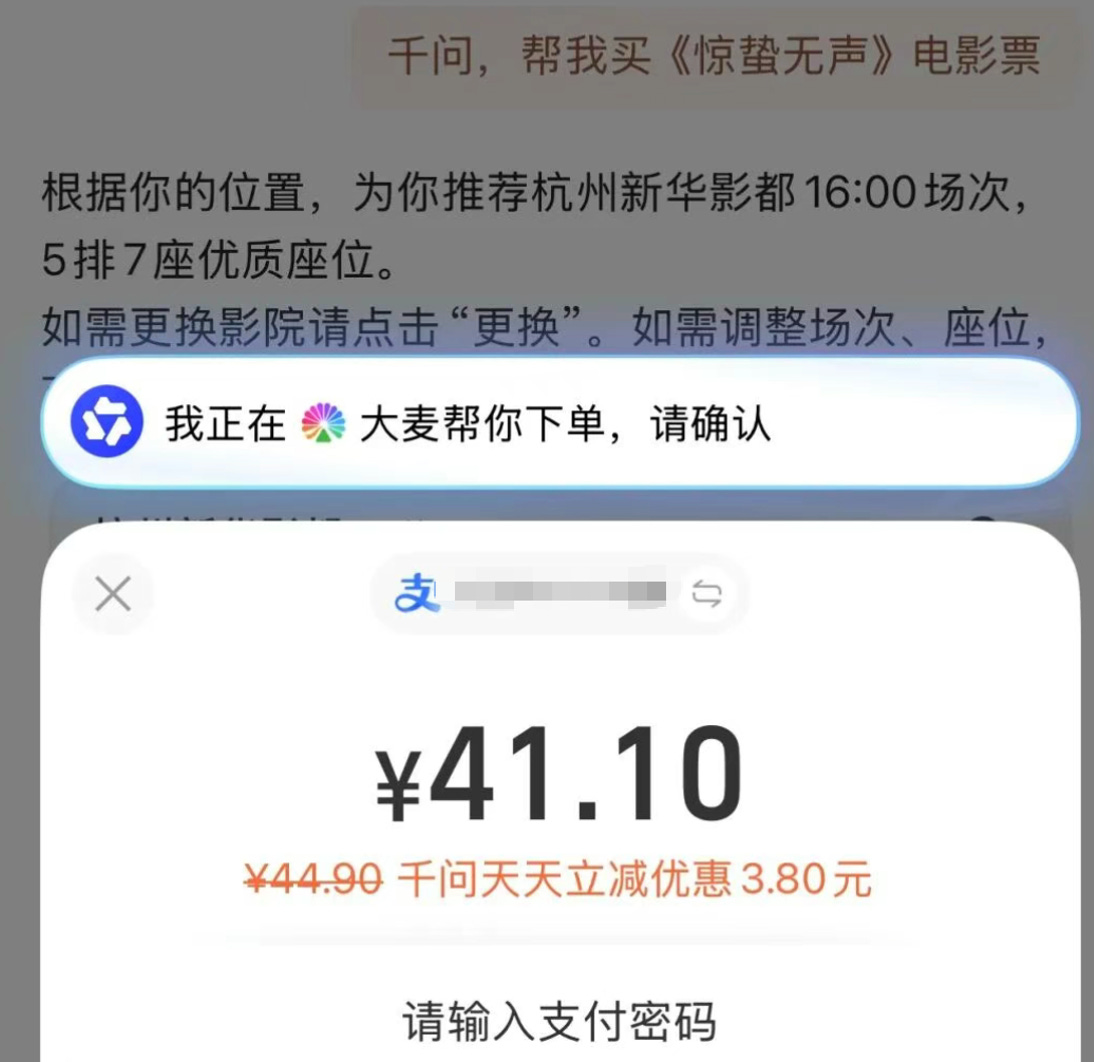
Two weeks ago was Lunar New Year. My parents did something that surprised me so much! I thought Stanford is “hyper”/ “advanced” enough in AI, but my 50+-year-old parents, they used Qwen, Alibaba’s AI chatbot, to buy movie tickets, and I haven’t done even once.
No app-switching. No scrolling through showtimes. Just a simple conversation:
“Buy me a movie ticket of xx,”
and the AI handled the rest: compared theaters, selected seats, and processed the payment through Alipay. Done.
My parents are not early tech adopters. They’re just… normal parents.
And they are not alone. During Lunar New Year 2026, 4 million Chinese users aged 60 and above used AI agents to purchase movie tickets. Alipay’s AI Pay solution just crossed 120 million transactions in a single week. Let that number sink in.
Meanwhile, in the US, Perplexity, Gemini, OpenAI has launched agentic commerce way ahead, since late 2024 or 2025. The infrastructure is being built. The protocols are being debated. The analyst reports are bullish. As of Feb 2026, I still can’t order a movie ticket on Perplexity, ChatGPT or Gemini (it will show me the steps though).

When I look at the gap between where China is and where the US is on agentic commerce, I keep coming back to a question that’s been bugging me:
Why is agentic commerce already working in China, and why is it so hard to make it work in the US?
First, Let’s Define What We’re Talking About
“Agentic commerce” is when AI agents don’t just recommend products, and they actually complete purchases on your behalf (it can be with or without your confirmation on the final purchase). You tell the AI what you want, and it handles discovery, comparison, selection, checkout, and payment. The entire transaction loop, automated.
Think of it as the difference between asking a friend “what shoes should I buy?” (that’s a chatbot) versus saying “buy me running shoes under $100 that work for flat feet” and having them show up at your door (that’s agentic commerce).
The numbers suggest this isn’t a niche experiment anymore. Morgan Stanley projects $190–385 billion in US e-commerce agentic spending by 2030. McKinsey estimates the global opportunity at $3–5 trillion. Gartner predicts AI agents will intermediate $15 trillion in B2B purchasing by 2028 alone. ChatGPT is fielding 50 million shopping queries per day, roughly 2% of all prompts on the platform…
But wait…
The US: All the Trends Are Ready. Is It Coming?
If you only read the headlines, you would think the US is about to have its agentic commerce moment. And honestly, a lot of the building blocks are in place.
The demand signal is real. LLM-referred traffic to retail sites grew 805% year-over-year. During Black Friday/Cyber Monday 2025, traffic from LLMs converted 3–7x higher than traditional channels and 3.6x higher than social. Amazon’s Rufus AI assistant doubled purchase sessions on Black Friday. Bank of America’s proprietary credit card data shows a material acceleration in online spending since early 2025—and one of the possible drivers they cite is AI-assisted shopping.
The protocols are launching. OpenAI and Stripe released ACP (Agentic Commerce Protocol) in September 2025, powering ChatGPT’s Instant Checkout. Google and Shopify countered with UCP (Universal Commerce Protocol) at NRF in January 2026, backed by Walmart, Target, Etsy, Wayfair, Mastercard, Visa, and 20+ partners. Microsoft adopted ACP for Copilot. Even Reddit just announced an AI product search experience.
The payment rails exist. Stripe, PayPal, Shopify Payments, etc. the US has world-class fintech infrastructure.
So what’s the problem?
The Structural Hurdles
The Value Chain Is Fragmented, By Design
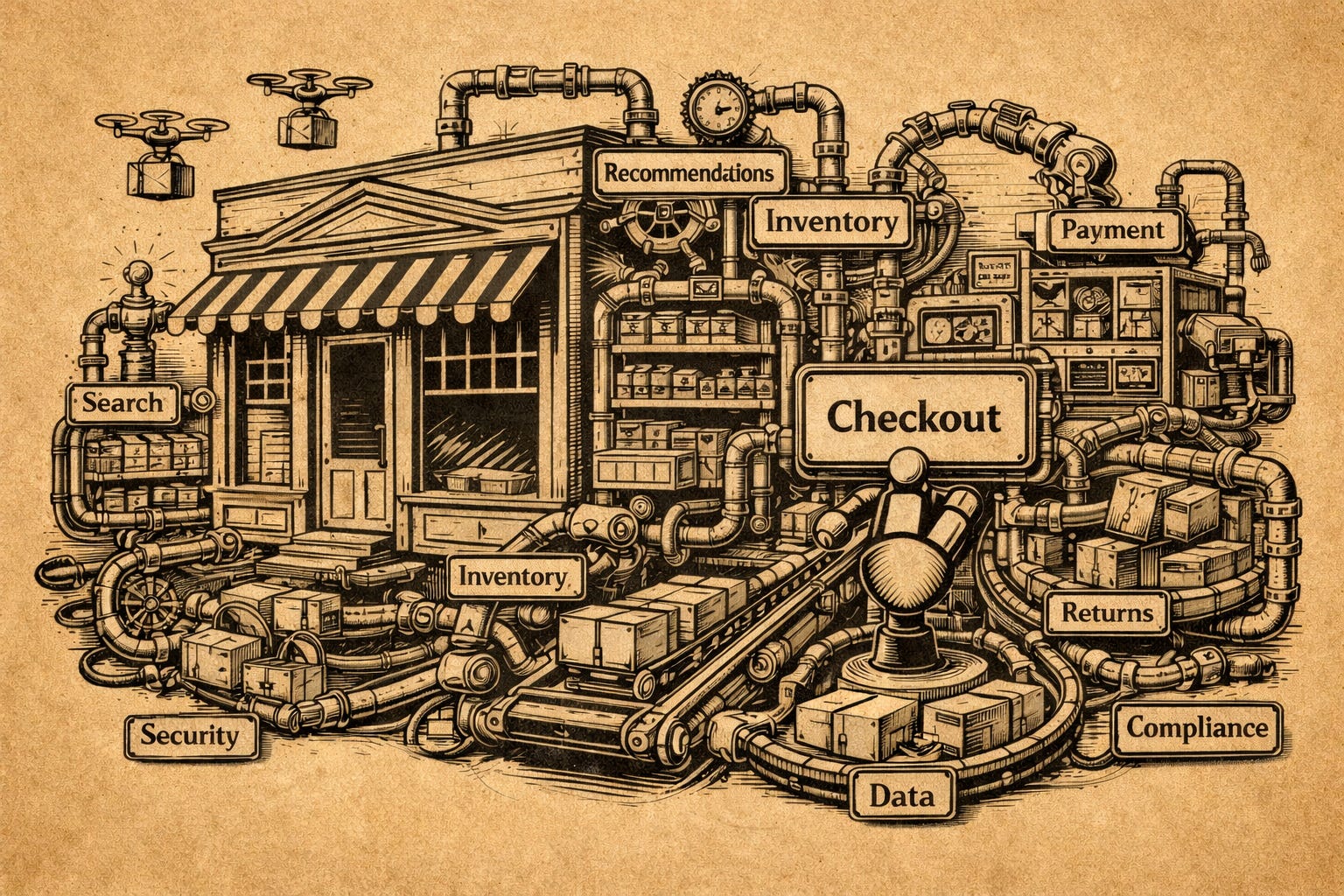
This is the big one. In the US, the ecommerce stack is deliberately decentralized. You have separate companies handling search (Google), discovery (TikTok, Instagram), storefronts (Shopify, BigCommerce), ecommerce (Amazon, Walmart), payments (Stripe, PayPal), fulfillment (UPS, merchants themselves, etc), and customer data (everyone fighting over it).
For an AI agent to complete a purchase end-to-end, it needs to stitch together all these players. That’s exactly what ACP and UCP are trying to do, but getting competitors to cooperate on shared infrastructure is like herding cats.
Consider: Shopify’s earnings call in February 2026 was revealing. When a Wall Street analyst asked Shopify’s President Harley Finkelstein to compare UCP (which Shopify co-developed with Google) versus ACP (OpenAI + Stripe), Finkelstein mentioned UCP 21 times and ACP exactly zero times. Industry insiders suggest there may be tension between Shopify and OpenAI over how the economics of ACP get divided among four parties: Stripe, Shopify, OpenAI, and the merchant.
When the protocol layer itself is a battleground, widespread adoption gets complicated.
The Data Ownership Problem
Here’s a tension nobody wants to talk about openly: who owns the customer?
When a consumer buys through ChatGPT’s Instant Checkout, the merchant is technically the “merchant of record” as they handle fulfillment and customer service. But do they get the conversational context? The browsing behavior? The comparison data that led to the purchase decision?
Brands and payment firms like PayPal are deeply uncomfortable handing over transactional data to OpenAI. If OpenAI keeps the behavioral intelligence while merchants just get order notifications, you’re paying for distribution and getting blindness in return.
The “Agentic Tax” Is Just Getting Started
OpenAI currently charges a 4% fee on ChatGPT Instant Checkout purchases, on top of existing payment processing fees (~2.9% + $0.30 for Stripe). So a $100 order costs the merchant roughly $7.20 in platform and processing fees.
At 4%, it’s cheaper than Amazon’s 8–15% referral fees. It looks reasonable today. But remember: TikTok Shop launched in Southeast Asia with low commissions. Merchants piled in. Dependency built. Today the fees in some markets exceed 16%. Amazon didn’t start at 10%+. The pattern is consistent: low entry pricing to build adoption, then steady extraction once switching costs make leaving painful.
If ChatGPT becomes a major shopping channel and with 900 million users, it very well could—will that 4% stay at 4%? History suggests otherwise.
Google’s UCP and Microsoft’s Copilot currently charge zero extra fees. But “free for now” is a business development strategy, not a business model.
China: Why It’s (Comparatively) Easy
Now look east, and you see a completely different picture.
The Super App Advantage Is Real
China’s agentic commerce isn’t being built from scratch, as it’s being layered onto super apps that already own the entire value chain.
When Alibaba updated Qwen in January 2026 to support agentic transactions, it connected directly to Taobao (products), Fliggy (travel), Amap (maps/local), and Alipay (payments). The Qwen integration supports over 400 core digital tasks. One ecosystem. One identity. One payment rail. No protocol wars needed.
ByteDance did the same with Doubao and Douyin. Tencent’s Martin Lau said on their May 2025 earnings call that AI agents would become core components of WeChat’s ecosystem, which already has 1.3 billion users with messaging, payments, ecommerce, and services all integrated.
Here is my take: Chinese firms like Alibaba, Tencent, and ByteDance all benefit from integrated ecosystems, rich behavioral data, and consumer familiarity with super apps. Western companies face more fragmented data and stricter privacy regulations, slowing cross-service integration.
The Coordination Problem Is Already Solved
In the US, getting OpenAI, Stripe, Shopify, Google, PayPal, and merchants to agree on standards is a massive coordination challenge. Each has different incentives, different data strategies, different monetization models.
In China, the super app model means one company controls the entire stack. Alibaba doesn’t need a protocol to get Taobao to talk to Alipay, as they’re the same company. There are no stakeholder conflicts of interest because the stakeholders are vertically integrated.
This structural advantage is enormous. Alipay launched the “Agentic Commerce Trust Protocol” in January 2026 with Qwen and Taobao Instant Commerce as launch partners. The speed from announcement to 120 million weekly transactions tells you what’s possible when you don’t need to negotiate across corporate boundaries.
Consumer Behavior Is Already Primed
Chinese consumers have been trained by a decade of super apps to do everything inside one interface. Paying for groceries via WeChat QR code, ordering food on Douyin, booking flights on Alipay. This behavior is normal. Adding an AI layer on top of existing flows feels like a natural evolution, not a paradigm shift.
In the US, consumers still navigate between Google, Amazon, brand websites, and separate payment apps. Getting them to trust an AI chatbot to complete a purchase with their credit card, in a conversational interface is a bigger behavioral leap.
The Business Model Is Still Evolving
Right now, the agentic commerce business model in the US looks something like this:
OpenAI/ChatGPT: 4% transaction fee (the “agentic tax”) + potential future advertising
Google/UCP: Free for now, likely monetized later through ad integration in AI Mode
Shopify: Payments processing fees (~2.9%) whether the checkout happens in-chat or on-site
Merchants: Pay the stack, keep the customer relationship (in theory)
But there are some fascinating emerging trends worth watching:
The Death of SEO, the Rise of AEO
If AI agents are the new front door to shopping, traditional SEO becomes less relevant. What matters instead is whether your product data is structured in a way that AI agents can read, evaluate, and transact on.
The industry is already calling this AEO (“Agent Engine Optimization”, or “Answer Engine Optimization”). It’s not about ranking on Google’s page one anymore. It’s about ensuring your product feeds, Schema.org markup, and merchant center data are clean enough for an AI agent to recommend and buy your product. The new SEO is data engineering.
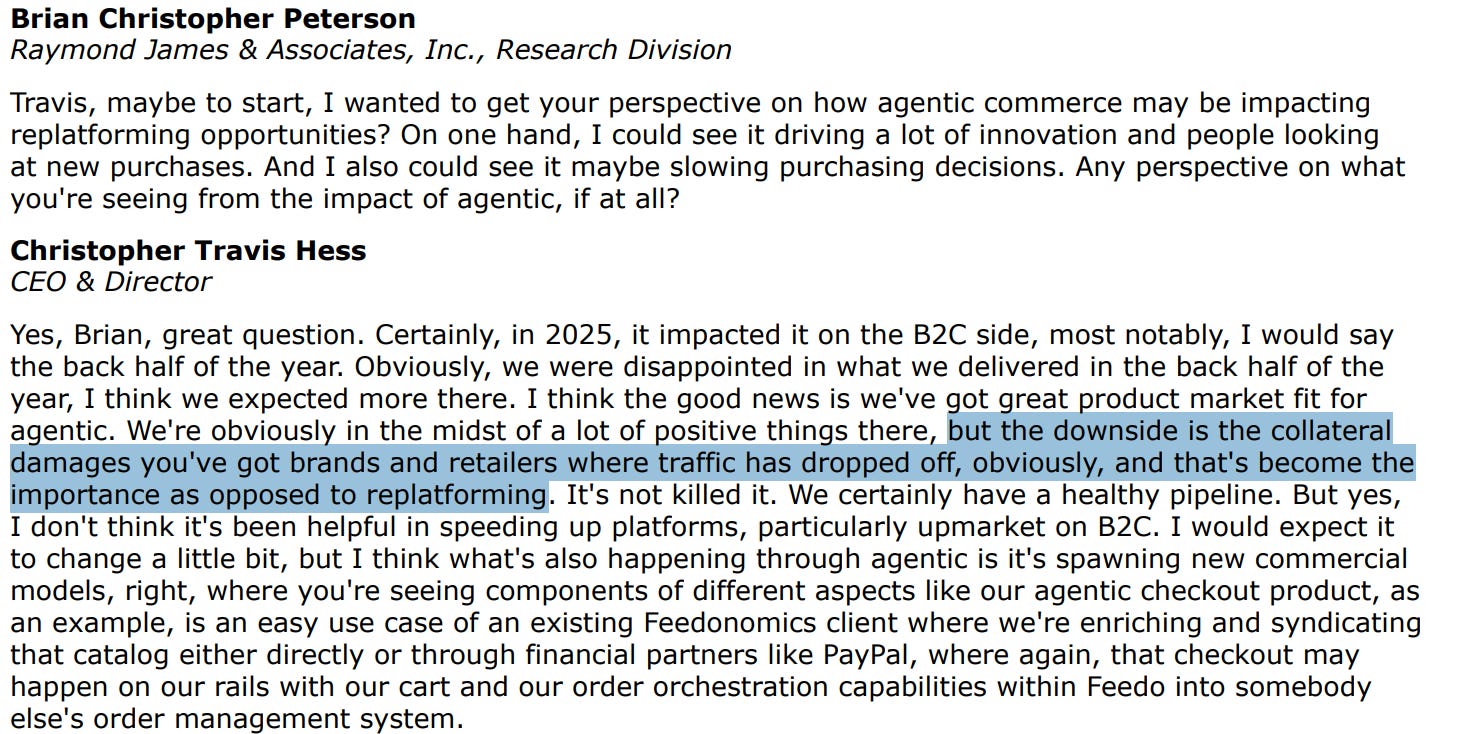
It’s quite interesting to see BigCommerce’s CEO acknowledged on their February 2026 earnings call that the “path to zero clicks” is having a material impact on their business. When consumers don’t visit your website because the AI agent handled everything, the website itself becomes less relevant. That’s a terrifying shift for any ecommerce platform whose value proposition is “we build your storefront.”
The Looming “Agent Commission”
Today it’s 4%. But the parallel to the App Store’s 30% cut is hard to ignore. If OpenAI and Google become the primary “front doors” for shopping, i.e., the way Google Search and the App Store became front doors for the web and mobile eras, they’ll have pricing power that grows with dependency.
The question for D2C brands: can your margins absorb 4% today, and whatever it becomes tomorrow? For many, especially smaller merchants operating on thin margins, the math could break.
B2B: The Quiet Giant
While the consumer side gets all the attention, the B2B opportunity might be bigger. Gartner forecasts that 90% of B2B purchasing will be AI-agent-intermediated by 2028, driving over $15 trillion through agent exchanges. B2B procurement, with its repetitive orders, complex approval workflows, multi-supplier negotiations, and compliance requirements, is arguably a better fit for AI agents than consumer impulse purchases.
Imagine procurement agents that continuously monitor inventory levels, compare supplier terms across hundreds of vendors, automatically trigger reorders, and even negotiate prices agent-to-agent. Forrester predicts that by end of 2026, 1 in 5 B2B sellers will face AI-powered buyer agents demanding dynamic counteroffers.
The Bigger Question: Where Is Commerce Heading?
Zoom out and you can trace a clear evolution:
Brick & mortar → Discovery commerce → Content commerce → Agentic commerce
We went from physically going to stores, to searching for products online (Google/Amazon era), to products finding us through content feeds (TikTok Shop, Instagram, live-streaming), and now to AI agents buying on our behalf.
But here’s what I keep thinking about: these models aren’t replacing each other. They’re accumulating. People still go to physical stores. People still Google things. People still scroll TikTok. And now people are chatting with AI to shop.
Consumers only have so much money in their pockets, just like so much attention. If every new commerce channel is additive rather than substitutive, who loses? Does the pie grow, or does everyone just get a thinner slice?
Maybe the deeper question is about what shopping actually is. Is it purely utilitarian—a problem to be solved as efficiently as possible? If so, agentic commerce wins. An AI that knows your sizes, preferences, and budget can objectively buy you better running shoes than you’d find yourself.
But is that what consumers want? Think about window shopping. Think about the joy of discovery, the serendipity of finding something you didn’t know you needed. Commerce has always been part process, part experience. If we optimize away the process entirely, do we lose something in the experience?
Or maybe different categories split differently. Toothpaste and laundry detergent? Let the agent handle it. A new winter coat or a gift for someone you love? That’s still a human experience.
Closing Thoughts
My parents aren’t cool, early-adopter types who chase every new technology wave. That’s exactly what amazes me. The fact that they, and millions of people like them, are casually using AI to buy movie tickets tells you something about how accessible and natural this technology is becoming in China.
The US will get there too but likely in different ways. The protocol wars between ACP and UCP, the data ownership battles, the fee structure negotiations, these are features of a competitive market. And I am very much excited about what’s down the road.
The commerce landscape will keep evolving. But something will not change.
On quiet Saturday afternoons in Stanford, when I open Amazon to order groceries (not ChatGPT yet), I’m suddenly transported back to those after-school afternoons as a kid, walking with my parents through the wet market, picking out vegetables and haggling over fish prices.
And then I close Amazon. And I get on my bike and ride out to Trader Joe’s to find something I didn’t know I was looking for.

If you’re interested in the intersection of AI and cross-cultural product observations, subscribe for more. I’m exploring these questions as a Stanford MBA student, coming from a non-technical background and curious about where this all goes.
The coordinated vs. fragmented ecosystems point is the one that keeps coming back. When one company owns discovery, payments, and fulfillment, agentic commerce is just a feature update. When it's a negotiation between a half-dozen players with different incentives, it's a whole new layer of complexity.